



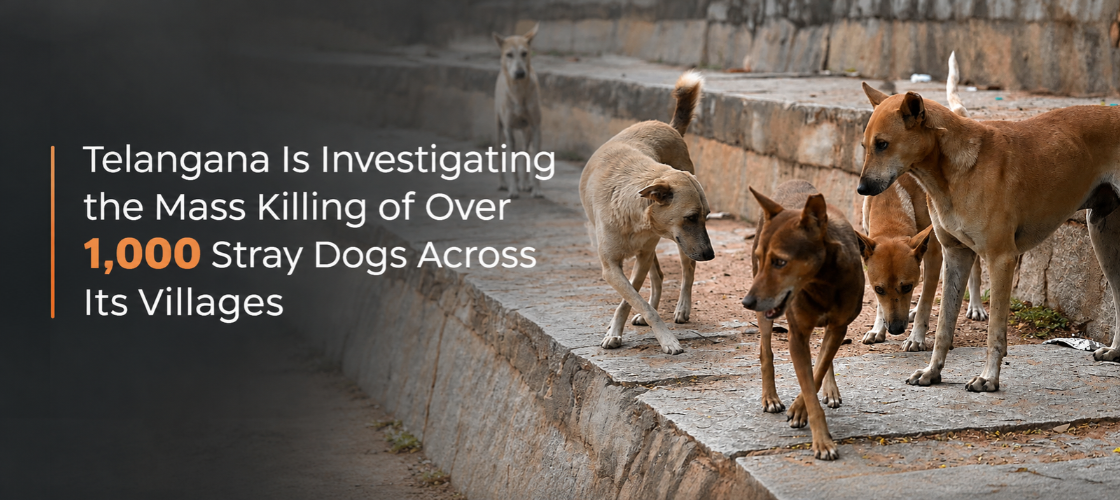
Telangana state authorities are investigating the mass killing of an estimated 1,000 or more stray dogs across multiple villages, in what animal welfare groups say was a systematic operation carried out to fulfil election promises made during December 2025 panchayat polls.
The killings were carried out by hired professionals who reportedly went from village to village injecting dogs with poison while they slept. At roughly Rs 500 per dog, the men worked through the night, buried the carcasses on village outskirts, and left before dawn. When animal welfare activists arrived and exhumed the bodies, they sent viscera samples to a Forensic Science Laboratory to determine what had been used.
Police have since registered cases against at least fifteen people across Kamareddy and Hanamkonda districts, including elected sarpanches, their family members, village secretaries, and daily-wage labourers. No arrests had been reported as of the time of writing.
How It Started
The immediate trigger was a complaint filed by Stray Animal Foundation of India activist A. Goutam, who was tipped off by villagers. Investigators traced the killings to five villages in Palwancha mandal in Kamareddy district and multiple villages in Hanamkonda district. The dogs in Pathipaka village in Hanamkonda’s Shayampeta mandal alone accounted for around 200 deaths.
Before the Gram Panchayat elections in December 2025, some candidates had allegedly promised voters they would deal with the problem of stray dogs and monkeys in their villages. After winning their seats, some of those same representatives are accused of acting on that promise by hiring people to carry out the killings.
Village elders, quoted in local coverage, defended the action. They said the dogs had become a nuisance during the election period and that what happened reflected public pressure, not criminal intent.
Animal welfare groups said that is precisely the problem. The legal framework does not create a carve-out for community preference or electoral convenience. Killing stray dogs is a criminal offence under the Prevention of Cruelty to Animals Act and runs directly against the Supreme Court-sanctioned Animal Birth Control programme, which requires that stray dogs be sterilised and vaccinated, not killed.
What the Law Says, and What Happened Anyway
India’s Animal Birth Control Rules require local bodies to manage stray dogs through sterilisation, vaccination, and return. The Supreme Court has repeatedly reinforced this framework while also responding to the separate and genuine problem of dog bite injuries. In January 2026, the Court was in its third consecutive day of hearings on stray dog attacks nationally. It noted that it did not want the matter to become a “debate between animal cruelty and dog attack cases” but acknowledged that rising bite incidents were creating real pressure on local authorities.
That pressure is part of the context in Telangana. Sarpanches are elected local officials with direct accountability to the people who voted for them. If voters say stray dogs are a threat and need to be removed, and if the state government provides no functional sterilisation infrastructure to offer as an alternative, the gap between what elected representatives are asked to do and what the law permits becomes a space where killings happen.
The ABC programme is meant to close that gap. The pattern across India is that it has not.
The Scale of What Was Found
The initial complaint concerned around 300 dogs in Kamareddy. Within days, additional reports came in from Hanamkonda. As investigators extended their inquiry across the state, the estimated total crossed 1,000. The scale suggests the operation was not a localised incident but a practice that spread, or was running in parallel, across villages in multiple districts.
Forensic results confirming the method and substance used in the killings were still pending at the time authorities began their investigation.
Cases have been registered under the Bharatiya Nyaya Sanhita and the Prevention of Cruelty to Animals Act. The accused have been issued notices. Whether prosecutions follow, and whether convictions result from them, is a separate question. In India’s history of animal cruelty cases, cases filed rarely end in meaningful legal consequences.
The BBC, reporting on the investigation, noted that hundreds of dogs were killed. The number being investigated by authorities is now considerably higher than that.

 November 3, 2026