



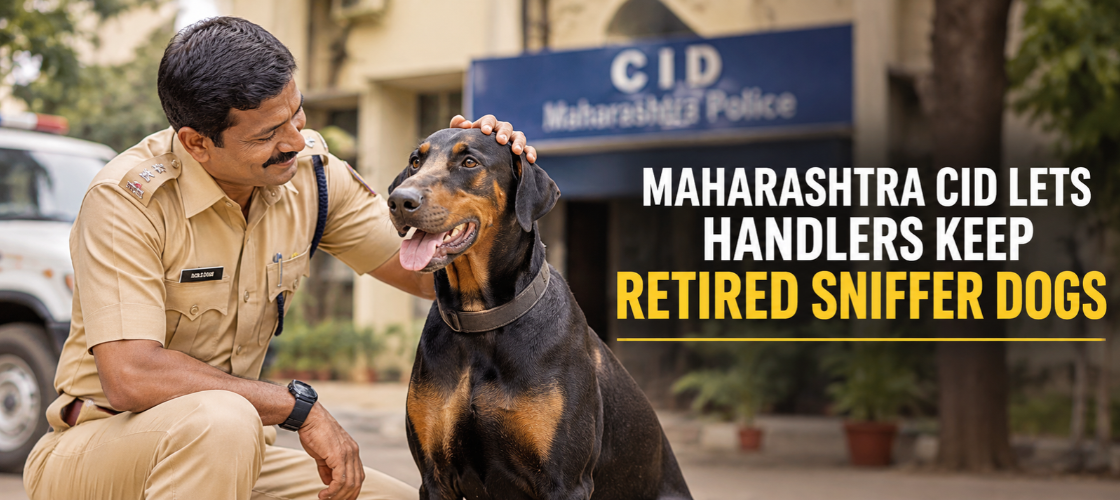
Maharashtra’s Crime Investigation Department is extending the state’s new retirement policy to its sniffer dog units, allowing handlers to keep their dogs at home after the animals complete their service. The move follows a broader decision by the state government in August 2026 that ended the practice of sending retired police dogs to adoption homes.
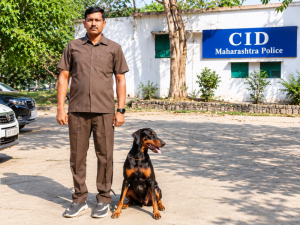
The change matters most to handlers like constable Gaikwad, who has worked alongside Arya, a Doberman, since 2016. Arya is due to retire in roughly three months. Under the old system, Gaikwad would have had no say in where the dog went. “It was very painful when we had to retire the dogs,” Gaikwad said, “but this decision has brought us great joy.”
What Changed
Until now, police dogs finishing their ten-year service were processed out of the force and typically placed with adoption families. The Home Department’s own review found that this arrangement frequently caused serious welfare problems. Dogs that had spent a decade bonded to a single handler, operating on fixed routines, often refused to eat when moved to new surroundings. Some became withdrawn and stopped functioning normally.
Chief Minister Devendra Fadnavis announced in August that dogs completing a decade of service should spend their remaining years with the people they know. Under the new arrangement, retired dogs stay with their handlers, and the Home Department covers food, medical treatment, and daily upkeep for the rest of the animal’s life.
Maharashtra CID, which runs its own dog units for explosive detection, narcotics work, and criminal tracing, is now implementing the same framework. Handlers whose dogs retire under the CID’s programme can formally keep the animals at home, with state-funded care continuing.
Why the Old System Was a Problem
Police dogs begin training between six and nine weeks of age. Their entire socialisation, their routines, their sense of safety, and their working identity are built around one handler. By the time a dog reaches retirement at around ten years old, that relationship is a decade in the making.
The adoption model treated retirement as a transfer of ownership to a civilian family. From the dog’s perspective, it was an abrupt removal from the only environment and the only person it had ever known. The refusal to eat that officials documented was not a minor adjustment difficulty. It was a stress response from an animal with no way to understand what had happened to its life.
Constable Ashwin Thakur, who works with a dog unit, put the logic plainly: “If he stays with us, we will take good care of him after retirement.”
How Long These Dogs Actually Live
The numbers here are important context. Police dogs generally live one to one-and-a-half years after completing their ten years of active service. These are not animals who have a long retirement ahead of them. The window between the end of service and death is short, and spending it in an unfamiliar home with strangers rather than with a known handler is a particular kind of cruelty when measured against that timeline.
The state funding commitment is not a large financial ask. It is a short commitment to cover the final stretch of a working animal’s life in conditions that do not actively harm it.
The Broader Picture
Maharashtra is not the first state to move in this direction. Karnataka made a similar decision in 2019. Kerala followed in 2021. The pattern is consistent: states that review how retired service dogs are actually faring after adoption tend to conclude that the adoption model does not serve the animals well.
Mumbai Police flagged the same issue internally as far back as 2017, proposing funds to support retired sniffer dogs, but it took nearly a decade for the state to act on the principle.
The CID’s extension of the policy to its own units is the administrative follow-through that makes the August announcement real for the handlers and dogs within that department. For Gaikwad and Arya, and for the handlers coming after them, the difference is straightforward: the dog does not leave.

 October 30, 2026