



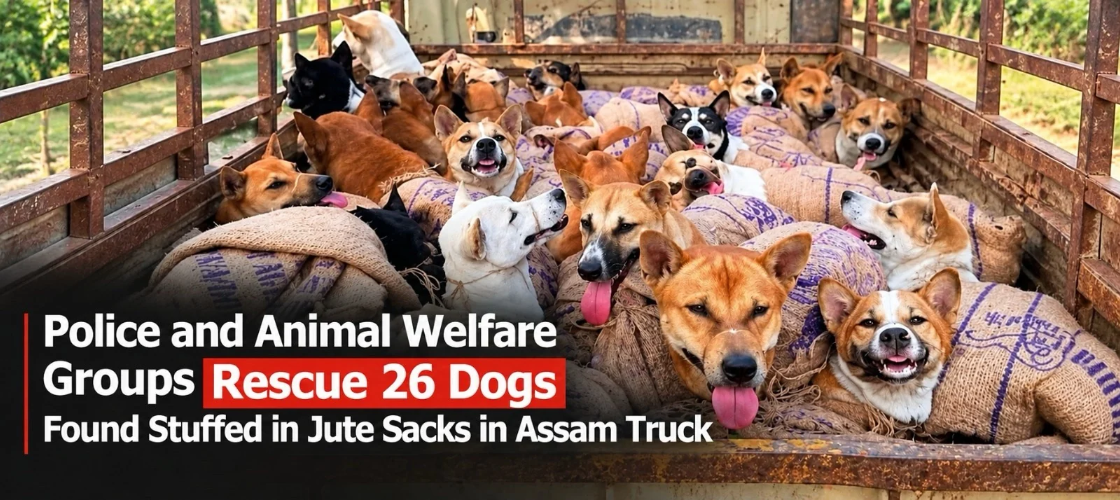
Twenty-six dogs were found crammed inside jute sacks with their mouths tied shut in a truck intercepted in Karbi Anglong district, Assam. The animals were allegedly being transported to be slaughtered.
Assam Police and four animal welfare organisations carried out the rescue. The dogs were taken to Just Be Friendly’s Integrated Care and Resource Centre for Animal Welfare in Guwahati, where they received veterinary treatment. Among the welfare groups involved was Humane World for Animals.
The condition of the animals when discovered pointed to a journey under significant stress. Stuffed into sacks with their mouths bound, the dogs had no room to move and no access to water or food. The sacks were loaded into the truck in a manner consistent with transport for slaughter rather than any other purpose.
The Dog Meat Trade in Assam
The northeast Indian states have a documented history of dog meat consumption, and Assam in particular has seen repeated interceptions of trucks carrying dogs from other parts of the country to meet local demand. Animal welfare groups have flagged Assam as a key transit corridor for the trade.
The Prevention of Cruelty to Animals Act prohibits the transport of animals in conditions that cause unnecessary suffering. Tying an animal’s mouth shut and confining it inside a sealed sack for hours constitutes a clear violation of those standards. Despite this, prosecutions in dog meat trade cases in India have been inconsistent. Seizures happen. Arrests and convictions are rarer.
In this case, no arrests were reported at the time the rescue was announced.
26 dogs. Stuffed into bags. Illegally transported for the dog meat trade. Our partners along with police in Assam, India intercepted the truck and rescued them. Now these dogs urgently need care. Please donate today to help animals: https://t.co/o6YCA2kLxb https://t.co/N1DCboQhpp
— Humane World for Animals (@humaneworldorg) October 29, 2026
What Happens to the Dogs
The 26 dogs rescued from the truck were brought to Just Be Friendly’s facility in Guwahati. The organisation runs one of the more established animal care operations in the state, and the dogs were assessed and treated for dehydration, stress, and any injuries sustained during transport.
The outcome for dogs rescued from situations like this varies. Some are rehabilitated and rehomed. Others, depending on their condition and temperament, spend extended periods in shelter care. In Assam, where shelter capacity is limited and adoption rates are low, long-term outcomes for rescued street dogs are not guaranteed to be substantially better than what they left behind.
What is certain is that these 26 did not reach their destination. That is the part that can be said without qualification.
A Pattern That Keeps Repeating
Rescues of this kind happen regularly across Assam and the broader northeast, and they follow a recognisable pattern. Police intercept a vehicle, animal groups step in to manage the animals, a rescue is announced, the dogs go to a facility, and the people running the operation are rarely held accountable in any lasting way.
Humane World for Animals, which has documented dog meat trade operations across India for years, has called for sustained enforcement rather than one-off seizures. Without follow-through on prosecutions, the economics of the trade remain largely unchanged. A truck that gets intercepted once in a while is a cost of doing business.
The 26 dogs in Karbi Anglong are the visible part of a supply chain that moves continuously. Whether this rescue leads to anything beyond the rescue itself will depend on what investigators do next.

 October 29, 2026