



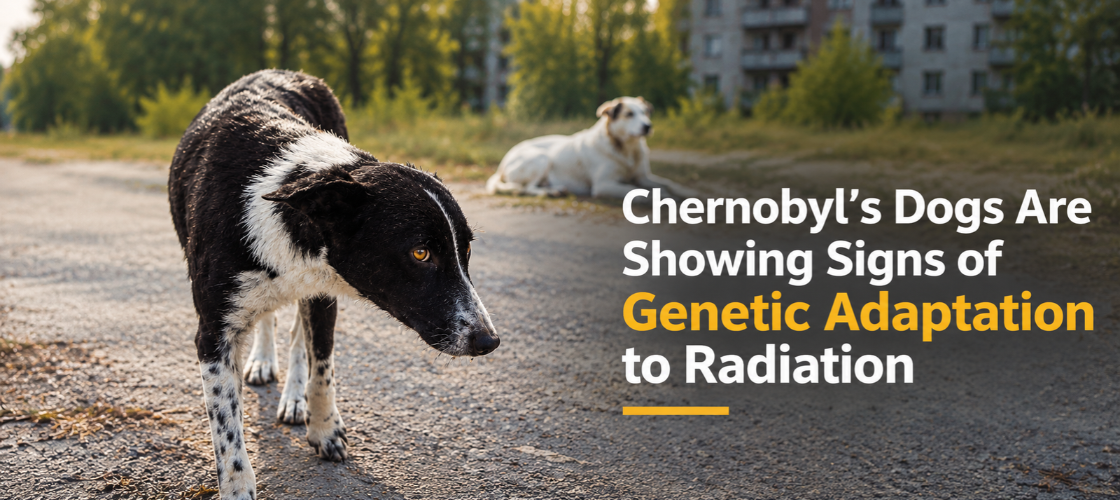
The dogs living near the Chernobyl Nuclear Power Plant have been surviving in one of the most contaminated environments on earth for decades. A new study suggests their genomes may show why.
Researchers at North Carolina State University analysed free-breeding dogs from two locations near Chornobyl: the area immediately around the nuclear power plant and Chornobyl City, about 16 kilometres away. Despite the short distance, the two populations are genetically distinct. The NPP dogs, as the plant-zone animals are called, showed evidence of directional selection at more than 100 genomic locations, with affected genes linked to cancer development, DNA repair, cell cycle regulation, and immune function.
The study, “Evidence of Selective Response in the Free-Breeding Dog Population in Chornobyl,” was published in the journal Genes in October 2026.
What Directional Selection Means Here
Directional selection is what happens when an environment consistently favours certain traits over others, and those traits become more common in the population over generations. It is distinct from genetic drift, which is the random shuffling of genes that tends to happen in small, isolated populations and often reduces genetic diversity.
The NPP population is small, which would normally point toward drift rather than selection. But the researchers compared the NPP dogs with other isolated populations, including a group from the Galápagos Islands, and found that the NPP dogs differed from those isolated groups in ways that could not be explained by isolation alone. The Chornobyl City dogs looked more like the Galápagos dogs than like their NPP neighbours 16 kilometres away.
The study, “Evidence of Selective Response in the Free-Breeding Dog Population in Chornobyl,” was published in the journal Genes in October 2026.
What the Genes Suggest
The genomic regions flagged by the study’s selection scans are associated with processes that would matter a great deal in a radiation-contaminated environment. DNA repair mechanisms. Cell cycle checkpoints. Cancer-related pathways. Immune regulation. These are exactly the systems that ionising radiation puts under stress.
Lead researcher Megan Dillon was careful about what the findings can claim. The signals are “suggestive of selection,” not confirmed as selection. Her co-author Matthew Breen offered one possible explanation: the dogs that survived the initial post-disaster radiation exposure may not have developed new genetic advantages from scratch. They may simply have already carried genetic variants that gave them better odds, and those variants became more common in the population as other dogs did not survive to reproduce.
That distinction matters. It is the difference between rapid evolution and a kind of brutal filtering of existing variation.
Chornobyl power plant dogs carry genetic signatures suggestive of selection at over 100 sites, including regions near genes linked to DNA repair. @ncstate https://t.co/QhvbCcQJwd
— Phys.org (@physorg_com) October 29, 2026
Background on the Chernobyl Dogs
The 1986 Chornobyl disaster released ionising radiation, heavy metals, and organic toxicants across the surrounding landscape. The exclusion zone was evacuated of people, but dogs were left behind or were born there over subsequent decades. A previous study established that the NPP and Chornobyl City dog populations are genetically distinct, with the NPP dogs showing differences specifically in DNA repair-related genomic regions.
This new study goes further by asking whether those differences reflect selection or something else. By introducing comparisons with Eastern European free-breeding dogs and the Galápagos population, the researchers built a framework to separate the effect of isolation from the effect of a chronically toxic environment.
The effective population size of the NPP group is small but comparable to the Chornobyl City population. Crucially, NPP dogs showed no significant reduction in genetic variation, which argues against the kind of inbreeding-related decline typical of small isolated groups. Their diversity is intact. The differences appear directional, not random.
Why It Matters
The researchers say the findings could help assess long-term ecological and genetic risks in chronically polluted environments and inform wildlife management in areas exposed to industrial contamination. If certain genetic profiles confer greater resistance to radiation or toxicant exposure, understanding those profiles has implications beyond Chornobyl.
The study does not claim these dogs are immune to radiation, or that they have evolved into something categorically different. What it does suggest is that forty years of living in a contaminated exclusion zone has left a measurable mark on their genomes, and that mark looks like adaptation rather than accident.

 October 28, 2026