



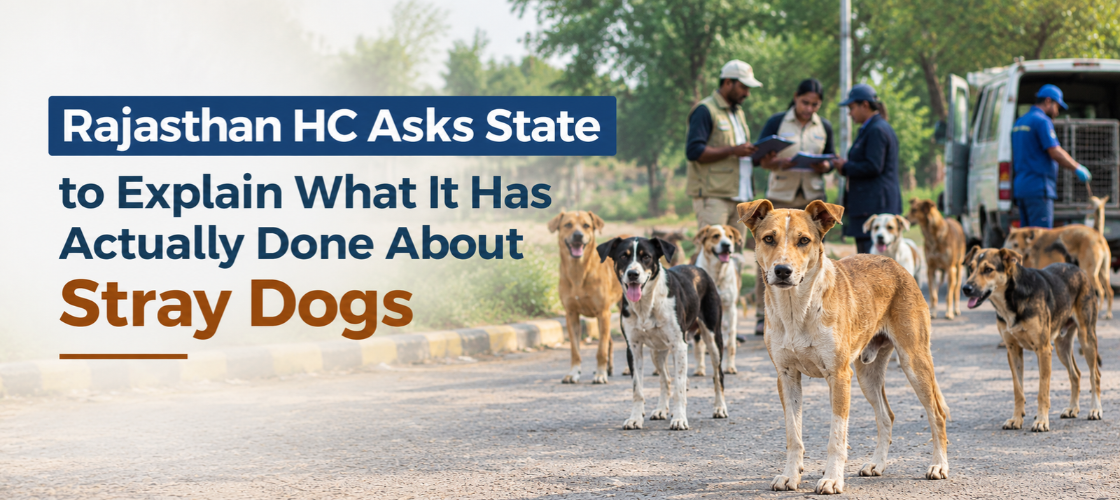
The Rajasthan High Court has sought an action-taken report from the state government on stray dog management. The court wants to know what steps authorities have taken since it began monitoring the issue, and whether any of the directions it issued have actually been carried out.
The case is a suo motu matter taken up by a division bench of Acting Chief Justice Sanjeev Prakash Sharma and Justice Maneesh Sharma. The court is tracking compliance with Supreme Court directions on stray dog management across the state.
What the Court Had Already Directed
Since taking up the matter in July 2026, the bench has issued a set of specific directions to state and local authorities.
Municipal bodies were told to create dedicated wings to remove stray dogs from public roads, with a focus on areas near schools, hospitals, sports complexes, and transport hubs. Captured dogs are to be sterilised and vaccinated under the Animal Birth Control Rules, 2023. Primary health centres and hospitals across the state were told to keep anti-rabies vaccines in stock. An accountability mechanism was to be set up for officials responsible for enforcement.
The state was also directed to introduce compulsory registration for pets that pose a risk to human life, with fines proposed for non-compliance. The Union of India and the Animal Welfare Board of India were put on notice to set up district-level welfare boards and frame a standard operating procedure for preventing dog bites.
At the August 2026 hearing, the Additional Advocate General GS Gill appeared for the state, and a compliance report was due.
Why the Court Is Still Asking
The action-taken report request in October signals that the court is not satisfied it has received a full account of what has been done. This is standard in suo motu matters of this kind, where directions are issued across multiple agencies and the court needs to verify whether each one has moved.
The pattern in stray dog management cases before Indian courts is consistent. Directions are issued, compliance reports are sought, the reports filed are often partial or describe plans rather than completed action, and the court asks again. Each follow-up hearing is a signal that the earlier directions have not been fully implemented.
The Broader Picture in Rajasthan
The court’s intervention started in August 2025, when a division bench took suo motu cognizance after news reports documented a series of stray dog bite incidents across the state. The bench noted at the time that the numbers were “alarming” and that city roads, state highways, and national highways could not remain unsafe.
Since then, a second bench has continued the matter at a higher pitch, issuing operational directions rather than just issuing notices. The current request for an action-taken report is the court’s way of holding the state to what it promised. Whether those reports reflect real change on the ground is something the next hearing will test.

 October 26, 2026