



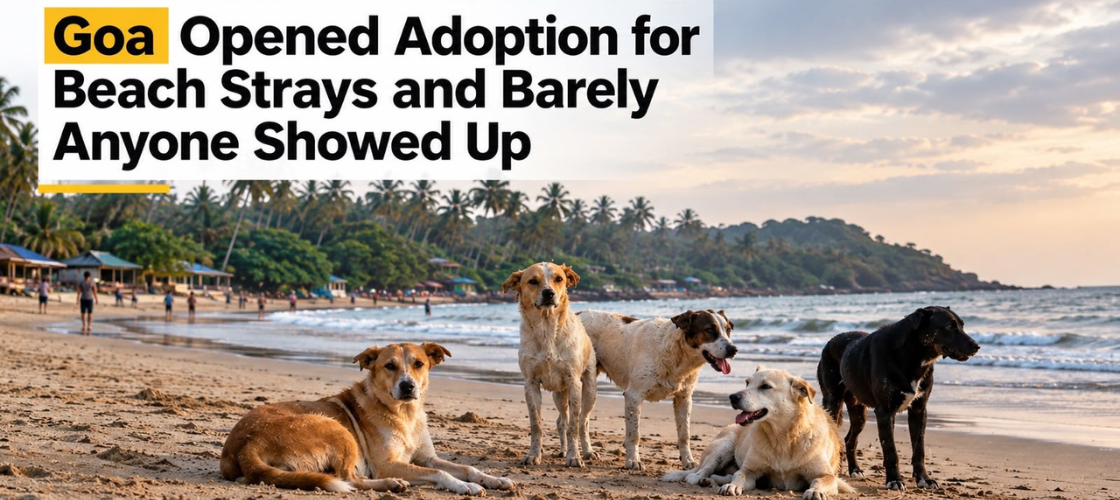
Goa’s Department of Tourism opened a seven-day window for residents, NGOs, and animal welfare groups to adopt stray dogs from the state’s beaches The notice went out on October 9. Applications were to be sent to Paryatan Bhavan in Panaji. The window has now closed.
The response was poor.
What the Government Offered
The adoption window was part of the state’s broader plan to clear strays from beach stretches before the tourist season. The Tourism Department, under pressure from the Supreme Court’s suo motu writ petition on stray dog management, framed beach areas as public places where dogs could be legally relocated if the conditions warranted it.
The offer was straightforward. Anyone who wanted to adopt a beach stray had to provide their name, address, proof of address, the number of dogs they intended to adopt, and a written undertaking to ensure the animals’ care, feeding, shelter, and welfare. The application went to the Tourism Department’s office.
Dogs that no one adopted would be sterilised, vaccinated, and moved to authorised shelters where legally permissible.
The Goa Tourism Department’s appeal to citizens, animal lovers and welfare organisations to adopt stray dogs from the state’s beaches has received no response, according to the department.
.
.
#Goa #GoaNews #TourismDepartment #Dogs https://t.co/WZkD5DGvru— In Goa 24×7 (@InGoa24x7) October 20, 2026
The Gap
For months, activists, veterinarians, and animal welfare organisations have been vocal opponents of the government’s plan to remove dogs from beaches. They called the shelter approach a “quick-fix political solution.” They said relocation without sustained ABC programmes would just shift the problem. They said the infrastructure was not in place. They were not wrong about any of that.
But when the adoption window opened, the same community that objected loudest to the removal plan was largely absent from the queue to adopt the dogs in question.
It is a familiar pattern in stray dog debates in India. The people most opposed to government action on strays tend to support community feeding and oppose culling or relocation, which are legitimate positions. The adoption ask, though, requires something concrete: taking an animal home, absorbing the cost, and accepting the responsibility. That part attracted far fewer takers than the protests did.
Where Things Stand
Goa’s tourist season is approaching. The state has faced repeated complaints from foreign visitors bitten by strays on beaches. Officials have been told that around 100 aggressive dogs are leading packs in high-footfall beach areas. The Supreme Court has noted the problem on record.
The government’s shelter plan remains underprepared. Capacities are not published, timelines are vague, and no agency has been clearly assigned to run the facilities. Critics are right that a shelter system stood up in weeks will not function well.
But the adoption window’s failure adds a different kind of pressure. The people who argued that these dogs belong on the beach, that relocation was cruel, and that the community would step up have now had a concrete opportunity to demonstrate that last part. The numbers suggest they did not.
The dogs are still on the beach. The season is weeks away. Neither side has a working solution.

 October 22, 2026