



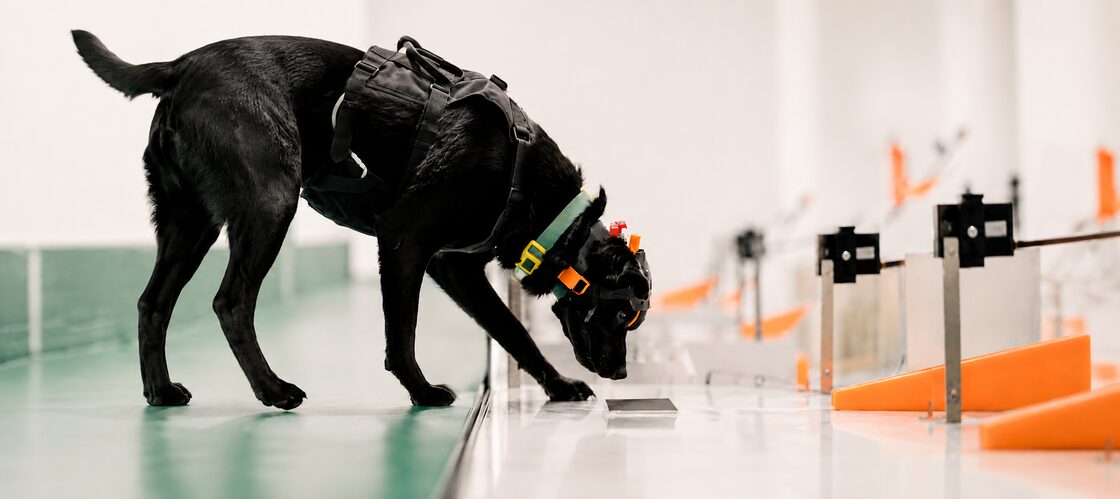
On a two-acre farm on the outskirts of Bengaluru, a team of beagles, labradors, and Dutch shepherds reports for work every day. Their job is to sniff out cancer. And according to early results, they are surprisingly good at it.
The startup behind this is Dognosis, a two-year-old Bengaluru-based company that is combining trained dogs with artificial intelligence to detect cancer from human breath samples. The idea sounds unconventional, but the science behind it has been building for years, and Dognosis is now one of a handful of companies globally trying to turn it into a scalable, affordable diagnostic tool.
How It Actually Works
The process starts with a face mask. Patients breathe into it for about ten minutes. The mask captures volatile organic compounds, or VOCs, which are chemical signals present in human breath that shift in the presence of diseases like cancer. Once sealed, the masks can retain their potency for up to three months, which means they can be shipped to Dognosis’s lab from anywhere in the country.
At the lab, trained dogs evaluate each sample inside a controlled testing setup fitted with sensors and monitoring systems. The dogs, which include Billy, Jessie, and Banu among others, have been trained to identify disease-related VOC signals through smell, a capability that dogs have been shown to possess across multiple independent research studies.
But Dognosis doesn’t stop at the dogs. A wearable brain-computer interface records each dog’s neural and behavioural responses as they work through the samples. That data is then fed into machine-learning algorithms that convert the dogs’ reactions into standardised, measurable readings, removing the subjectivity that comes with relying on animal behaviour alone.
Akash Kulgod, CEO and co-founder of Dognosis, describes it plainly: “That mask contains volatile organic compounds or VOCs, which essentially carry signals indicating whether a person has a disease or not. The masks are brought to our lab, where a team of trained dogs evaluates them and identifies these compounds with high accuracy.”
The product built around this system is called BreathEasy, and it generates a VOC risk score that clinicians can use to guide follow-up decisions.
The Results So Far
Phase 2 trials, conducted across 1,500 participants, showed 90 per cent accuracy in detecting cancer. The findings were published in the Journal of Clinical Oncology.
Oncologist Dr Swaratika Majumdar, who has been working with the company for about a year, called it “an early, easy, and inexpensive way of detecting cancers.” She noted that the 90 per cent sensitivity and specificity means the dogs are correctly identifying cancer in nine out of ten cases where it is present, a number that would be competitive with several conventional screening tools, particularly in an early-detection context.
Suba, Head of R&D at Dognosis, explained that consistency is central to what makes the AI layer meaningful. “Every sample presented here is presented in exactly the same way so that when the dog responds to it, we can record the outputs precisely.”
Phase 3 and What Comes Next
Dognosis kicked off its Phase 3 trial in April, working with ten hospitals across India. The plan is to recruit around 10,000 people over twelve months. The trial will focus on two groups: asymptomatic individuals at higher risk of developing cancer, and survivors who may be at risk of recurrence. Anyone flagged by the system will receive conventional follow-up, including imaging and biopsy, to verify the results.
If Phase 3 holds up, the company plans to launch commercially in Bengaluru first and then expand from there.
Why India, Why Now
Kulgod, who studied cognitive science at UC Berkeley before research grants took him to labs in Israel, Budapest, and the UK, founded Dognosis in 2024 along with Itamar Bitan, a former Israeli military dog handler he met during that period. He returned to India specifically because he believed this was where an affordable, non-invasive screening tool was most needed.
India diagnoses a large proportion of cancer cases at an advanced stage, when treatment becomes significantly harder and survival rates drop. A breath test that costs a fraction of an MRI or biopsy, and that can be deployed without specialist infrastructure, addresses a very specific and very real gap.

 October 15, 2026