






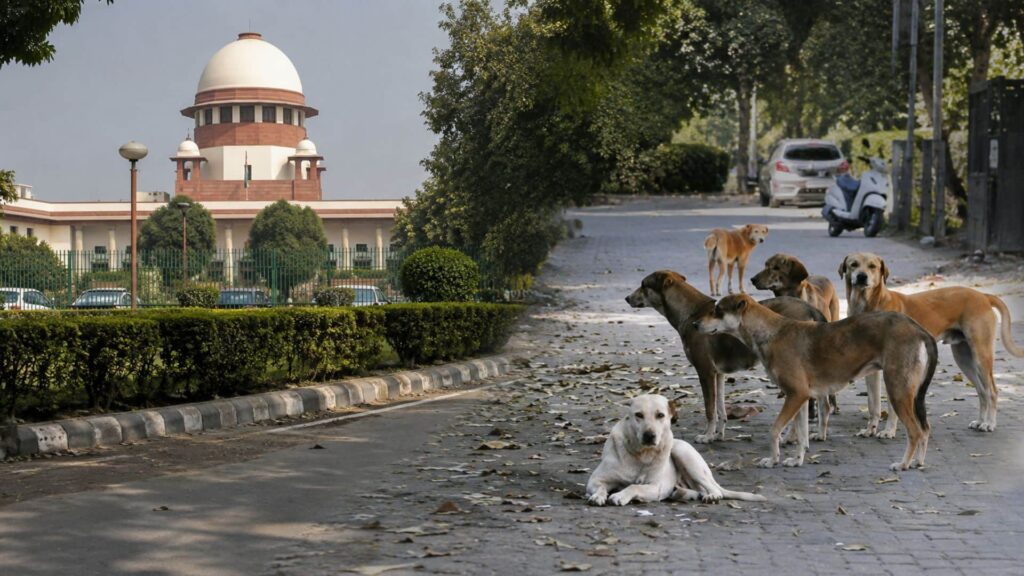
A bench declined to hear an NGO’s clarification request, directing them to the Punjab and Haryana High Court. But the larger question it leaves behind cannot be redirected so easily.
The Supreme Court on Monday declined to urgently hear a plea filed by NGO “Animals Are People Too,” which had flagged Punjab Chief Minister Bhagwant Mann’s remarks following the court’s own May 19 verdict on stray dogs.
The plea alleged that Punjab CM Mann had stated that the Supreme Court has given a “free hand” to kill stray dogs, a characterization that the NGO argued was both inaccurate and dangerous. The NGO’s counsel, Advocate Anil Kumar Mishra, submitted that the court’s May 19 order was allegedly being misunderstood and misused to justify the widespread killing of stray dogs in Punjab.
The bench of Justices Vikram Nath and Sandeep Mehta responded with a pointed question: “Just because a Chief Minister makes a statement, does that mean we have to change our order?” They then directed the petitioner to approach the Punjab and Haryana High Court, adding that strict compliance with the directions passed in the stray dogs case had to be ensured by the high courts.
What the May 19 Order Actually Said
The Supreme Court had on May 19 ordered that rabid, incurably ill or dangerous/aggressive dogs can be euthanised by proper authorities to curb a threat to human life and safety, subject to assessment by qualified veterinary experts and strictly in accordance with the provisions of the Prevention of Cruelty to Animals Act and other laws.
The order, in other words, was conditional and specific. It was not a sweeping directive to eliminate stray dogs. There is a world of difference between euthanising a certified rabid or irreversibly aggressive dog under veterinary oversight and launching a state-wide elimination campaign.
CM Mann had posted on X in Punjabi that “Following the Honourable Supreme Court’s decision, the Punjab government will launch a massive campaign starting tomorrow to eliminate stray and killer dogs that pose a threat to the lives of children and passersby.” That framing, advocates and animal welfare organisations argued, stretched the verdict far beyond what it actually permitted.
Punjab government will strictly follow in letter and spirit the Supreme Court order given on 19th May 2026. As per the SC orders, we will:
– Remove stray dogs from all high footfall public spaces so that children, senior citizens and families can move freely without fearing for…— Bhagwant Mann (@BhagwantMann) May 22, 2026
The Court’s Silence Is Not an Endorsement
The Supreme Court’s refusal to entertain this specific mention does not mean the concerns raised are invalid. Courts decline urgent hearings for procedural reasons all the time. The bench noted that the Supreme Court had already permitted High Courts to continue monitoring issues relating to stray dogs and implementation of related directions, which is why they redirected the petitioner there.
That is the system working as designed. But design and ground reality are often two different things.
When a sitting Chief Minister publicly declares a “massive campaign” against stray dogs in the wake of a nuanced, condition-heavy court order, it sends a signal down the administrative chain that precision no longer matters. Municipal workers, local officials, and contractors on the ground do not operate on legal nuance. They operate on a political signal. And the political signal here was loud.
Why This Fight Belongs to All of Us
At DogExpress, we are not neutral observers on this issue. We have spent years documenting the lives, struggles, and value that India’s stray dog population brings to communities across the country. We have reported on responsible ABC (Animal Birth Control) programs, on feeders facing harassment, on dogs being poisoned or beaten without any official accountability.
The May 19 Supreme Court order, read carefully, is not the catastrophe some feared. The court did not abandon its earlier positions on humane treatment. What it did was acknowledge that unchecked dog aggression is a public safety problem requiring a solution. That is a legitimate concern. Attacks, particularly on children, are real and harrowing.
But the solution has to be measured. It has to follow protocol. It has to involve a veterinary assessment. And crucially, it cannot become a cover for the indiscriminate killing of healthy, non-aggressive strays who happen to be visible and inconvenient.
The NGO had specifically argued that it only wanted a clarification that the Supreme Court’s euthanasia directions applied strictly to rabid, incurably ill, or demonstrably dangerous dogs and not to healthy stray dogs. That is a reasonable ask. It is, frankly, a conservative ask. The fact that such a clarification even needed to be sought tells you how quickly political rhetoric can distort legal reality.
What Needs to Happen Now
The Punjab and Haryana High Court now holds the most immediate threat to this. Animal welfare organisations, feeders, resident welfare associations, and anyone who cares about the treatment of animals in Punjab should be watching that space closely and lending whatever support they can to legal efforts there.
Beyond Punjab, every state should be placed on notice. The May 19 order was not a green light for campaigns. It was a conditional, carefully bounded permission for a specific intervention under specific circumstances. Any state administration that treats it otherwise is misreading the law and should be held accountable for doing so.
The Supreme Court was right that it cannot revisit an order every time a politician makes a statement about it. But those of us outside the courtroom have a different responsibility. We can keep watching, keep reporting, and keep speaking up every time a stray dog’s life is ended without justification.
India has millions of stray dogs. They are part of our streets, our neighbourhoods, our daily lives. The answer to the very real problem of dog bites and public safety is not elimination. It is systemic, sustained, humane management. That takes investment, political will, and genuine commitment to ABC programs that have been consistently underfunded for decades.
The NGO did the right thing by filing this plea. The court’s redirection is not a door closing. It is a door moving. The fight continues, and it needs more voices behind it.

 October 23, 2026