



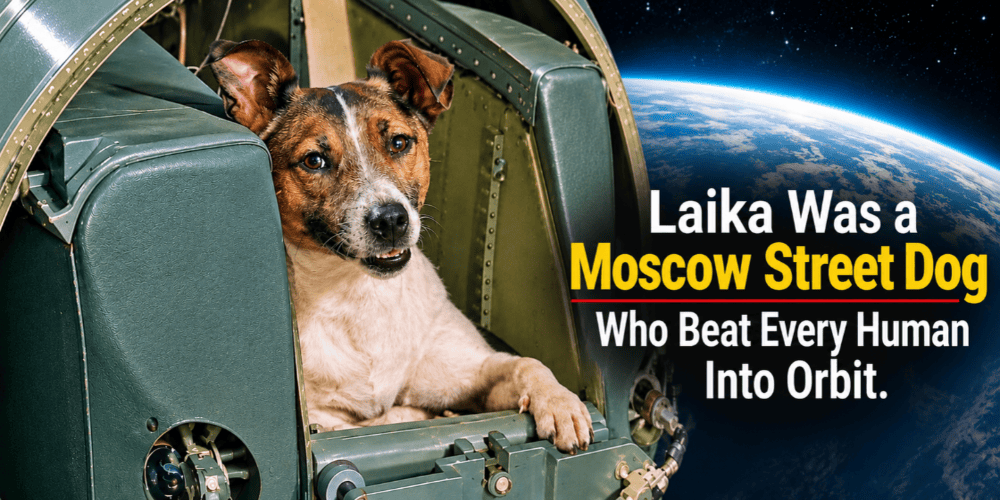
Sixty-nine years ago today, a three-year-old stray from the streets of Moscow became the first living creature to orbit the Earth. She did not come back.
Her name was Laika, loosely translated as “Barker.” Soviet scientists had pulled her off the streets of Moscow, along with other female strays, on the theory that dogs already accustomed to cold and hunger would cope better with the stresses of spaceflight. She weighed about five kilograms. She was part husky, possibly part terrier. She was given several names before the one that stuck.
Sputnik 2 launched on November 3, 1957. Laika was inside.
Why a Stray Dog
The Soviet space programme’s dog selection process was deliberate. Strays were preferred over pets because they were already conditioned to deprivation. Female dogs were preferred because the life support suits were easier to design for them. Size mattered. Temperament mattered. Laika was chosen as the primary flight dog ten days before launch. Her backup, Albina, was reportedly passed over partly because the engineers had grown too attached to her, since she had recently had puppies.
The dogs were trained in progressively smaller cages, kept confined for up to twenty days at a time to simulate the capsule. They were run through centrifuges and noise chambers to prepare for launch conditions. They learned to eat a nutrient gel that would serve as their food in orbit.
None of this was leisurely. Premier Nikita Khrushchev wanted a spectacle for the 40th anniversary of the October Revolution. Sputnik 2 was assembled in under four weeks.
What the Mission Was
Sputnik 2 carried a pressurised cabin with padding, a harness, and instruments to monitor Laika’s heart rate, breathing, and blood pressure. There was an oxygen generator and a cooling fan. The food and water were in gel form. The craft was roughly four metres tall.
There was no return system. The mission was designed from the start as one-way. Whether this was presented to the public as a plan or as a technical limitation depended on which Soviet statement you read, and when.
Telemetry confirmed Laika survived the launch. She reached orbit. She became the first living creature in Earth orbit.
आज इंसान अंतरिक्ष में लंबी दूरी की यात्रा कर रहा है. अंतरराष्ट्रीय स्पेस स्टेशन पर महीनों तक रह रहा है और चांद-मंगल तक पहुंचने की तैयारी कर रहा है. लेकिन क्या आप जानते हैं कि इंसानों से पहले अंतरिक्ष में एक कुत्ते को भेजा गया था? यह सड़कों पर घूमने वाली एक आवारा डॉगी थी और इसका नाम लाइका था.
पूरी खबर https://t.co/y4KycqcAPw
#Laika #SpaceHistory #SpaceExploration #FirstDogInSpace
— AajTak (@aajtak) November 3, 2026
What Actually Happened
The Soviet government’s initial account said Laika had been euthanised after about a week, when her oxygen ran out, and that she had died painlessly. This was not true.
The core stage of the rocket failed to separate as planned. This disabled the thermal control system. Insulation tore away from the cabin. The interior temperature climbed to around 40 degrees Celsius. Laika died within hours, during approximately the fourth orbit.
The batteries failed on November 10, 1957. Sputnik 2 continued circling the Earth for another five months before it re-entered the atmosphere and burned up on April 14, 1958.
The Soviet government gave conflicting explanations over the years. The truth came out in October 2002, when scientist Dimitri Malashenkov publicly disclosed what had actually happened. Laika had been dead for hours, not days, and had not died peacefully.
In 1998, Oleg Gazenko, one of the scientists who worked with her, said: “We did not learn enough from this mission to justify the death of the dog.”
What Her Death Changed
The mission was not without consequence for the programme that followed it. Sputnik 2’s launch, alongside Sputnik 1, alarmed American officials. Robert Gilruth, who later became the first director of what is now NASA’s Johnson Space Center, reportedly said after seeing Laika go up: “My God, we better get going.”
Later Soviet dog missions were designed differently. Belka and Strelka returned safely from orbit in August 1960. Other dogs died in subsequent missions, but the programme had at least shifted toward recovery.
The direct line from Laika’s flight runs to Yuri Gagarin’s orbital mission in April 1961. She demonstrated that a living creature could survive launch and orbit, even if the mission told Soviet engineers almost nothing useful before she died.
How She Is Remembered
Laika has a statue at Star City, unveiled in 1997. A small figure of her appears on Moscow’s 1964 Monument to the Conquerors of Space. A separate monument was built in 2008 near the facility where her flight was prepared.
Her image appeared on Soviet stamps, cigarette packs, and matchboxes. Nick Abadzis’s 2007 graphic novel about her won awards. A Norwegian singer performed a tribute song that made it to Eurovision selection in 2025.
The BBC, marking today’s anniversary, has called her an icon of Soviet space exploration. She was a stray dog from Moscow who had no say in any of it.

 November 2, 2026