



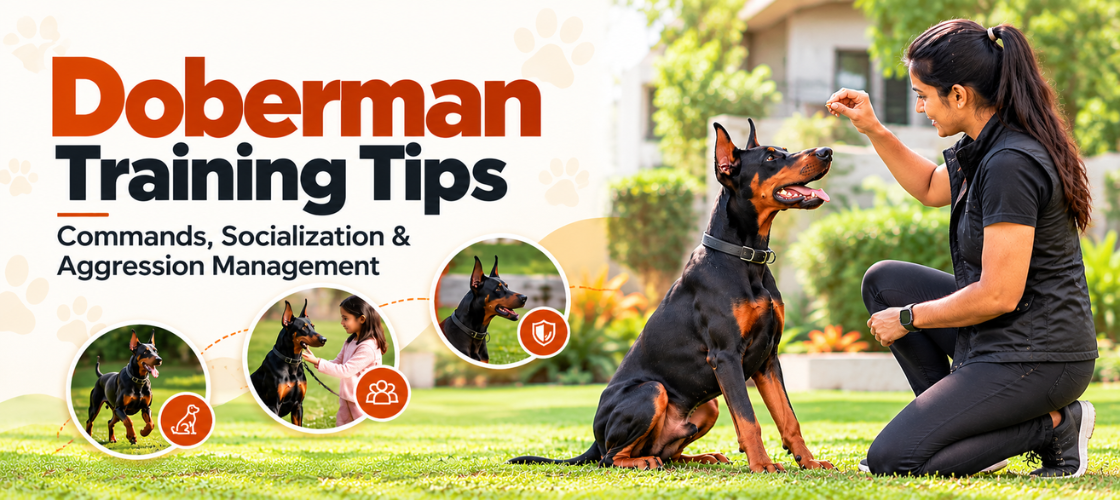
Owning a Doberman is a responsibility that most people who want one underestimate and most people who actually have one take seriously. The breed is intelligent, loyal, physically powerful, and has protective instincts that are genuinely useful when properly managed and genuinely dangerous when they’re not. Doberman training tips that treat this breed like a Labrador or a Poodle miss the point. The Doberman requires structured training not as a nicety but as a safety requirement for the dog, the owner, and anyone who interacts with either.
This guide covers the Doberman training tips and management approach that produces a Doberman that is reliable, calm, and safe in the Indian household context.
The Training Non-Negotiables for Dobermans
Sit, stay, down, come, and leave it are the five foundation commands that every Doberman must have before anything else is added. These are not optional — they are the minimum required to manage a dog this size and with this level of drive safely. A Doberman that does not have a reliable recall and a solid down-stay is a dog that cannot be managed in unpredictable situations.
According to the American Kennel Club, the Doberman consistently ranks among the most intelligent breeds and is capable of learning complex commands in very few repetitions. That intelligence accelerates training when it’s working in your favour and accelerates problem behaviour when it isn’t.
Positive Reinforcement and Drive-Based Training
For most Indian pet owners, a positive reinforcement approach using food and play as primary motivators is appropriate and sufficient for a well-adjusted companion. Food motivation is high in Dobermans, which makes reward-based training effective.
Recommended: Petverse Automatic Pet Feeder 4.5L for Dogs

Dobermans do better with predictable routines than variable ones. An automatic feeder ensures mealtimes happen at consistent times even when household schedules vary, which reduces food-anxiety-related behaviour in a breed that can develop resource guarding if feeding is inconsistent. The camera also lets you monitor the dog’s demeanour at meal times, which is a useful behaviour indicator for a breed where subtle changes in behaviour often precede more significant problems.
Socialization: The Most Critical Doberman Training Requirement
An undersocialized Doberman is a serious problem. The breed’s protective instincts, size, and physical capability mean that fear-based reactivity or aggression in a poorly socialized Doberman has consequences that the same issue in a small breed would not. Socialization must begin in the critical window of 3 to 14 weeks and must be extensive.
For Indian Doberman owners, this means deliberate exposure to: different types of people including children, uniformed workers, elderly people; different animals; different environments; and the full range of sounds and stimuli in Indian urban life.
Recommended: ZEXSAZONE Round Donut Pet Bed

A Doberman that has a defined rest spot in the household is a more settled dog than one that roams freely without a designated space. The donut bed’s enclosed shape provides the physical sense of security that reduces ambient anxiety in this alert breed. A calm, rested Doberman is a more trainable and more predictably behaved one — the quality of rest directly affects the dog’s arousal baseline during waking hours.
Managing Protective Instincts
A Doberman’s protective instincts are not something to eliminate — they are part of what makes the breed valuable as a guardian. The goal is to ensure those instincts are channelled appropriately and governed by reliable obedience. A Doberman that has solid obedience and has been extensively socialized will make better decisions about when protective behaviour is warranted than one that has not.
Specific problem management: a Doberman that growls at strangers in inappropriate contexts needs both obedience training and desensitisation to the specific trigger. The growl is not to be punished — it is communication — but the underlying anxiety or threat perception needs to be addressed through controlled, positive exposure.
The Consistency Requirement
Dobermans are attentive enough to notice inconsistency and confident enough to test limits when they find them. Rules that apply some days but not others produce a dog that constantly negotiates. Rules that are enforced consistently from day one produce a dog that understands the structure and operates within it. Every person in the household applies the same rules, every time.
Conclusion
The Doberman training tips that make the biggest difference are socialization in the puppy period and consistent, consequence-based obedience training that builds to a high standard before the dog reaches physical maturity. The investment is concentrated in the first year. The payoff is a decade-plus of a dog that is genuinely safe, genuinely reliable, and genuinely rewarding to live with.
FAQs
My Doberman puppy is showing aggression toward guests. Is this normal at 4 months?
Growling or barking at unfamiliar people at 4 months is within the range of normal for a breed with protective instincts. A puppy that can be redirected and that relaxes once it’s clear the visitor is not a threat is showing appropriate wariness. A puppy that cannot be redirected or that escalates despite your presence needs professional assessment sooner rather than later.
Can I train a Doberman without professional help?
For basic obedience, yes — most owners can train sit, stay, come, and down reliably using positive reinforcement. For anything related to protection training, aggression management, or complex behaviour problems, professional guidance from a trainer experienced with the breed is strongly recommended.
At what age should I start obedience training my Doberman?
From 8 weeks. Formal group training classes are appropriate from 10 to 12 weeks, after the vaccine schedule allows. Waiting until 6 months means the dog has already developed habits that are harder to change.
Is a Doberman safe in a household with children?
A well-socialized, well-trained Doberman that has grown up with children in the home is generally safe with those specific children. The variable is always the quality of socialization and training, not the breed in the abstract.

 October 16, 2026