



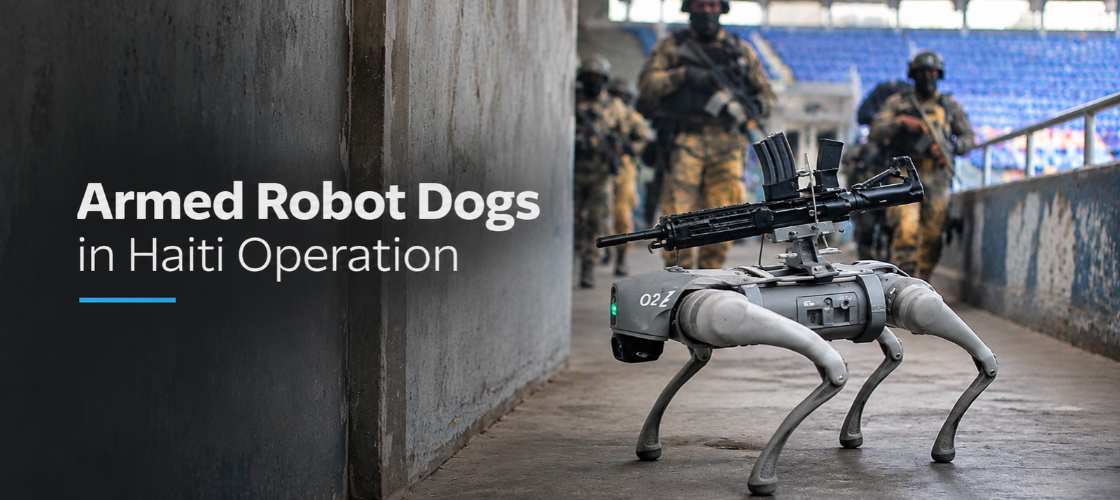
A striking video from Haiti has brought a new kind of “dog” into the spotlight. Footage released by El Salvador’s President Nayib Bukele shows rifle-equipped robotic dogs moving alongside troops during an operation to retake the Sylvio Cator Stadium in Port-au-Prince.
The joint operation involving Haitian and Salvadoran forces took place on November 12, as authorities moved to regain control of the national stadium from gangs. The footage shows the four-legged machines moving through narrow passageways and climbing stairs inside the facility.
While the machines look like dogs at first glance, they are fully robotic quadrupeds. Their appearance during a real security operation has also raised questions about how increasingly advanced robot dogs could be used in dangerous environments.
Robot Dogs Join Troops Inside Haiti Stadium
According to footage shared by Bukele, the robotic dogs were equipped with rifles and cameras as they moved through parts of the stadium.
The machines were seen travelling through corridors and navigating areas that could potentially be difficult or dangerous for human personnel. However, it remains unclear exactly how the robots were used during the operation or whether their weapons were fired.
That distinction is important. The available footage shows the robots carrying weapons, but it does not establish that they independently targeted or attacked anyone.
Reports have identified the machines as commercial quadruped robots, with some specialist reports identifying them as Unitree Go2 models. The identification of the specific robot model and weapon has not been officially confirmed by the Salvadoran government.
Why Was the Stadium Being Retaken?
Sylvio Cator Stadium, Haiti’s national football stadium in Port-au-Prince, had been under gang control for an extended period.
The latest operation was carried out jointly by the Haitian National Police, Haitian Armed Forces, a government task force and Salvadoran special forces under a bilateral security agreement. Following the operation, Bukele said the stadium would be turned into an operational base from which forces could continue moving into gang-controlled areas.
The operation is part of a wider Salvadoran military presence in Haiti. El Salvador sent more than 2,000 troops after four Salvadoran personnel went missing following an October 18 ambush in Haiti. What began as a response to their disappearance has since developed into a broader operation against powerful gangs in the country.
El Salvador’s President Nayib Bukele has released a video showing armed robots during an operation against gangs at the main stadium in Port-au-Prince, Haiti.
The stadium has been under gang control for the last two years. https://t.co/BoYaeLrfBw
— Al Jazeera English (@AJEnglish) November 13, 2026
Human Remains Were Reportedly Found Inside
The stadium operation also uncovered disturbing evidence of the violence surrounding the area. Bukele said several human skulls were discovered inside the stadium during the operation. Independent reports also carried the claim, although the circumstances surrounding the remains were not fully detailed in the available reports.
The stadium is now expected to serve a different purpose, with Salvadoran and Haitian forces planning to use it as a base for further security operations.
What Makes These Robot Dogs Different?
Robot dogs have increasingly moved beyond laboratories and technology demonstrations into real-world applications.
Four-legged robots can move across uneven surfaces, climb stairs and carry cameras or other equipment. These capabilities make them useful for situations where sending a person into an unfamiliar or potentially dangerous area could carry greater risks.
The Haiti footage, however, shows a more controversial use. The machines were fitted with rifles, making the incident notable not simply because robot dogs were present, but because commercially available quadruped technology was shown carrying weapons during an active security operation.
Specialist reporting has suggested that the robots seen in the footage were Unitree Go2 models. One report also identified the mounted weapon as an IWI ARAD-5 rifle and described the modification as a field-built system. These details should be treated as reported identifications rather than confirmed specifications from the Salvadoran government.
The Role of the Robot Dogs Remains Unclear
Despite the striking footage, there is still limited information about what the robots actually did during the operation.
The video shows them moving through the stadium with troops, but it does not provide enough evidence to establish whether they were used for surveillance, reconnaissance, security or another purpose.
There is also no clear evidence in the available reporting that the robots independently operated their weapons. This makes it important not to describe them as autonomous attack dogs or claim that they fired on gang members without further confirmation.
For now, what is known is that armed robotic dogs were visibly part of the operation and were being used in an environment where troops were confronting a serious security threat.
What This Means for the Future of Robot Dogs
The use of robot dogs in Haiti highlights how quickly four-legged robotics are moving from experimental technology into practical applications.
Robot dogs were originally associated with research, inspection, filming and industrial work. Their ability to move like animals while carrying cameras and equipment has since attracted interest from security and defence organisations.
The Haiti footage shows another side of that development. A machine designed to imitate the movement of a dog can now be adapted for situations involving significant danger.
That does not make these machines animals. They do not experience fear, pain or stress in the way a living dog does. But their dog-like appearance can make their use particularly striking to the public.
For dog lovers, the story is therefore less about a new kind of animal and more about how technology is borrowing one of nature’s most recognisable forms to perform tasks once carried out only by people or trained working dogs.
DogExpress Editorial View
Robot dogs are a remarkable example of how technology continues to take inspiration from animals. Their ability to move through difficult spaces could have useful applications in search, inspection, rescue and other situations where human safety is a concern.
But the Haiti footage also shows why the development of such technology deserves careful attention.
A robot may look like a dog, move like a dog and even work alongside people in situations where real working dogs might once have been considered. Yet it is still a machine, and the purpose for which that machine is used matters.
As robot dogs become more capable and more widely available, the conversation should not focus only on what these machines can do. It should also consider where they should be used, how they are controlled and what limits should govern their use.
For DogExpress, the most striking part of this story is not simply that a robot dog carried a rifle. It is that technology has reached a point where the familiar form of a dog is being recreated for roles far removed from the companionship, assistance and service traditionally associated with real dogs.

 November 16, 2026