






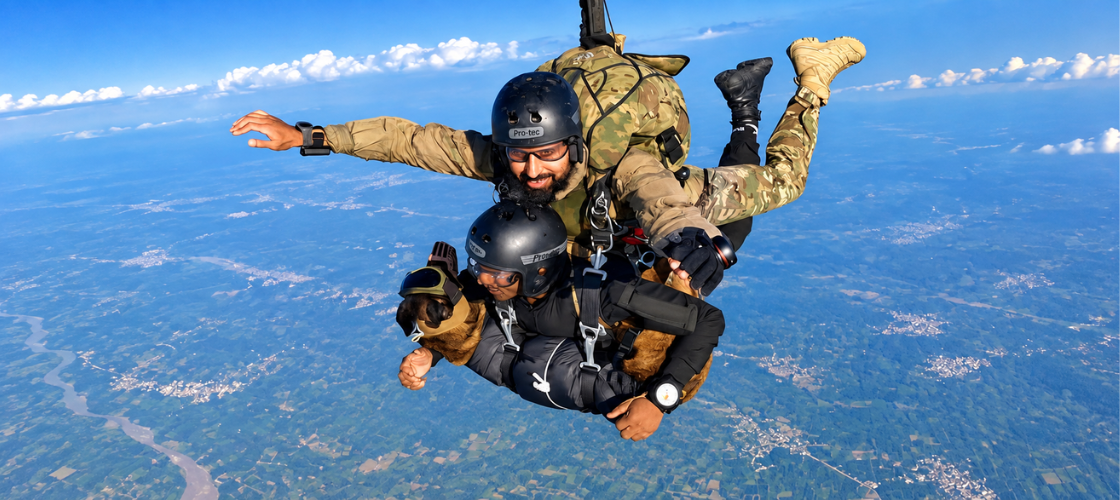
On September 15, a paratrooper from the Indian Army’s Surya Command stepped out of an aircraft over the Behat Drop Zone in central India. Alongside him was a dog handler. And strapped in for the descent was a combat canine.
The tandem parachute jump, carried out under full combat load, is believed to be the first of its kind in India. Three people, one of them not technically a person, fell from the sky together and landed in one piece.
The Army named it “Paws in the Sky, Courage on the Ground.”
What a Tandem Jump With a Dog Actually Involves
A standard tandem parachute jump already requires significant training and trust between two people. Add a combat dog into the equation and the complexity multiplies fast. The animal cannot be briefed, cannot pull a ripcord, and cannot communicate discomfort or fear the way a human co-jumper can. The handler has to manage the dog’s stress response mid-freefall, maintain a secure hold throughout the descent, and coordinate with the paratrooper, all while carrying a full combat load.
The Surya Command described the jump as a demonstration of “courage, precision and combat readiness,” adding that it showcased the ability of a handler and combat canine to undertake a tandem descent together under combat-load conditions. The Army noted that the exercise built on earlier free-fall jumps in which dogs had already participated, but this was the first time a handler and canine made the descent together in tandem configuration.
“This is a shining example of the trust, teamwork and unbreakable bond between the soldier and his canine partner, both ready for every mission,” Surya Command said in a post on X.
“𝗣𝗮𝘄𝘀 𝗶𝗻 𝘁𝗵𝗲 𝗦𝗸𝘆, 𝗖𝗼𝘂𝗿𝗮𝗴𝗲 𝗼𝗻 𝘁𝗵𝗲 𝗚𝗿𝗼𝘂𝗻𝗱.”
In a remarkable display of courage, precision and combat readiness, a paratrooper of #SuryaWarrior undertook a tandem parachute jump over Behat DZ with a dog handler and his combat canine, carrying a full… pic.twitter.com/4S48kbNKCm
— SuryaCommand_IA (@suryacommand) September 15, 2026
Why This Matters Operationally
Military working dogs are not ceremonial. They detect explosives and mines, track individuals across difficult terrain, assist in counter-terrorism operations, guard installations, and support disaster response and search-and-rescue missions. In mountain and jungle warfare scenarios, their ability to reach areas before human teams and alert handlers to threats has proven valuable enough that militaries around the world have invested heavily in integrating dogs into increasingly complex operational setups.
Airborne deployment is the natural extension of that. If a unit is being inserted behind enemy lines or into a denied area by parachute, leaving the dog behind means losing a significant capability. The ability to bring a combat canine along for an aerial insertion, already trained and ready to work the moment boots, and paws, hit the ground, closes that gap.
India is not the first country to train dogs for airborne operations. The United States military has used military working dogs in tandem HALO (High Altitude Low Opening) jumps since the early 2000s. Sri Lanka’s Teesha, a Golden Retriever who served as an explosive search dog, completed a high-altitude parachute jump with her handler back in 2015. But for the Indian Army, this jump at Behat marks a meaningful step in bringing that capability into its own operational toolkit.
The Dogs Behind the Uniform
India’s military working dogs are raised and trained by the Remount and Veterinary Corps (RVC) Centre and College in Meerut. The corps handles everything from breeding and early training to specialist preparation for counter-terrorism, tracking, mine detection, and disaster response roles.
Earlier this year, the Army’s animal contingent, which included both Indian-breed dogs and conventional military dogs, marched on Kartavya Path during Republic Day for the first time, a public recognition of the role these animals play in operations across some of the country’s most demanding terrain.
The Behat jump is a different kind of recognition. Quieter, technical, and tucked into a training exercise rather than a parade. But the significance of it is the same: these dogs go where the mission goes, and the Indian Army is making sure they can get there by any means necessary.

 September 16, 2026